According to the Bureau of Labor Statistics, about 1.1 million US workers were paid just the federal minimum wage in 2013. The average Wall Street bonus paid at the end of 2013 was about $164,000 with all the bonuses adding up to about $26.7 billion. That $26.7 billion is twice the combined earnings of the 1.1 million people making minimum wage.
It's important to remember that, once we the taxpayers bailed out Wall Street in 2008, one of the first things the big banks did was pay bonuses. That was a transfer -- redistribution -- from the average American to the wealthiest. Suggest redistribution of wealth from the 1% (or 0.1%) to the average, and Republicans and Democrats go into hysterics. (Pres. Obama has called for equality of opportunity, but not for more just outcomes or redistribution.)
For 35 years, both parties have repeatedly endorsed policies that have taken from the little held by the average and poorer and redistributed it upward. This is the point made by Joseph Stiglitz, Anthony Atkinson, Thomas Piketty, and many other progressive economists. And it is a point willfully ignored or dismissed by conservative economists who still dominate economic thinking in the US. The economist John Roemer has made the point that so great an indifference to fact by so large a percentage of economists counts heavily against economics being a science.
___________________
Roemer has a nice survey essay: The Ideological and Political Roots of American Inequality
Showing posts with label Wall Street. Show all posts
Showing posts with label Wall Street. Show all posts
Saturday, May 2, 2015


Monday, January 21, 2013
Obama Inaugurated for Second Term — Big, Fat, Hairy Deal
Economist and New York Times essayist Paul Krugman today suggests that progressives take a break from our "anxiety" and take some solace in the few, modest accomplishments of the Obama administration.
No.
I'm unclear whether Paul Krugman thinks Obama's 'accomplishments' are a "Big (so what!) Deal" or a "Big (wow . . . almost) Deal." And "anxiety" is an interesting choice of words — just that little bit demeaning, disparaging.
As for the substance of Krugman's claims:
Nobody disputes that inequality in the US will continue to grow (with Obama and most Democrats seeming to embrace that, modest palaver to the contrary notwithstanding), and social mobility will continue to decline.
We'll see whether health care in the US improves. Massachusetts is more of a mixed story than Obama-supporters will admit. Insurers got everything they demanded from Obama.
As for financial reform, Wall Street is just as petulant as the NRA — and more powerful. Ninety-nine percent of American revile Wall Street, yet the oligarchs still get most of what they demanded. But they are spoilt brats. Unless they get 110 percent of their demands they whine about how hard-done-to they are.
Unmentioned are any international issues. The world has learned that Obama is as bad or worse than Bush: drone strikes; assassinations (including of American citizens); uninterrupted funding for Israeli occupation; denial of due process for all accused to terrorism; a different and poorer standard of justice for Muslims and Arabs; vicious and unprecedented abuse of whistleblowers and activists for openness (most recently, Aaron Swartz). And nothing at all on climate change.
Sorry, I'm not going to take a break. And it's not anxiety. It's fury.
Monday, May 21, 2012
Romney, Obama and the Cult of Divine Right of Wealth
Paul Krugman today writes that Romney's defense of Jamie Dimon and JPMorgan Chase suggests cluelessness.
Romney isn't clueless — he's malicious. Huge difference. Like all of the advocates of Wall Street, including Timothy Geithner and Barack Obama most of the time, there is a deep, profound, dangerous streak of maliciousness at work. These are people who want to transfer wealth from the average to the rich, from labor to capital. These are people who firmly, devoutly believe in the divine right, the divine of superiority of wealth.
As conservative economist and Romney adviser Gregory Mankiw made clear in his blog a few years ago, conservatives (including most Democrats, like Obama) believe that the wealthy are genetically superior. These statements are made explicitly so there is no point pretending that this is a misinterpretation.
It is commonplace now to hear assertions of the genetic coding of morality, or every aspect of human behavior. The cult of reductionism to genetic, pseudo-Darwinian explanations is fully embedded in the popular discourse. Obama, Geithner, Romney, Mankiw, Dimon, Blankfein, Bloomberg all hold the absolute conviction that the wealthy are genetically superior. This is a profoundly dangerous state of mind. We have seen i it before. We know where it leads.
UPDATE
Krugman also has a blog post commenting on the blind, mindless ignorance of economist Edward Lazear (at Stanford and that right-wing haven of war criminals, the Hoover Institution).
As in his op-ed essay today (May 21), Paul Krugman is very generous to conservatives (and the many Democrats who follow their lead, as Obama does). Mitt Romney, Edward Lazear, Gregory Mankiw, David Brooks, Jamie Dimon, Lloyd Blankfein, and others like them are malicious, mean-spirited advocates of the transfer of wealth from labor to capital, from average and poor to rich. Worse, they are convinced of the genetic superiority of the wealth, convinced that the poor are genetically pre-disposed to stay poor.
It cannot be overstated how dangerous their thinking is.
Romney isn't clueless — he's malicious. Huge difference. Like all of the advocates of Wall Street, including Timothy Geithner and Barack Obama most of the time, there is a deep, profound, dangerous streak of maliciousness at work. These are people who want to transfer wealth from the average to the rich, from labor to capital. These are people who firmly, devoutly believe in the divine right, the divine of superiority of wealth.
As conservative economist and Romney adviser Gregory Mankiw made clear in his blog a few years ago, conservatives (including most Democrats, like Obama) believe that the wealthy are genetically superior. These statements are made explicitly so there is no point pretending that this is a misinterpretation.
It is commonplace now to hear assertions of the genetic coding of morality, or every aspect of human behavior. The cult of reductionism to genetic, pseudo-Darwinian explanations is fully embedded in the popular discourse. Obama, Geithner, Romney, Mankiw, Dimon, Blankfein, Bloomberg all hold the absolute conviction that the wealthy are genetically superior. This is a profoundly dangerous state of mind. We have seen i it before. We know where it leads.
UPDATE
Krugman also has a blog post commenting on the blind, mindless ignorance of economist Edward Lazear (at Stanford and that right-wing haven of war criminals, the Hoover Institution).
As in his op-ed essay today (May 21), Paul Krugman is very generous to conservatives (and the many Democrats who follow their lead, as Obama does). Mitt Romney, Edward Lazear, Gregory Mankiw, David Brooks, Jamie Dimon, Lloyd Blankfein, and others like them are malicious, mean-spirited advocates of the transfer of wealth from labor to capital, from average and poor to rich. Worse, they are convinced of the genetic superiority of the wealth, convinced that the poor are genetically pre-disposed to stay poor.
It cannot be overstated how dangerous their thinking is.
Tuesday, May 4, 2010
Economics by Analogy
Simon Johnson of MIT and The Baseline Scenario draws attention to recent claptrap from Larry Summers (who seems capable of little more):
“Most Observers” Do Not Agree With Larry Summers On Banking
By Simon Johnson
What is the basis for major policy decisions in the United States? Is it years of careful study, using the concentration of knowledge and expertise for which this country is known and respected around the world? Or is it some unfounded assertions, backed by no data at all?
At least in terms of the White House policy towards megabanks, it is currently “no discussion of data or facts, please”.
Speaking on the Lehrer NewsHour last week, Larry Summers said, with regard to the Brown-Kaufman SAFE banking act – which would restrict the size of our largest banks (putting them back to where they were a decade or so ago):
“Most observers who study this believe that to try to break banks up into a lot of little pieces would hurt our ability to serve large companies, and hurt the competitiveness of the United States.”
“But that’s not the important issue, they believe that it would actually make us less stable. Because the individual banks would be less diversified, and therefore at greater risk of failing because they wouldn’t have profits in one area to turn to when a different area got in trouble.
“And most observers believe that dealing with the simultaneous failure of many small institutions would actually generate more need for bailouts and reliance on taxpayers than the current economic environment.”
I’ve looked into these claims carefully and really cannot find any hard evidence supporting Summers’s position – and therefore US policy. To be sure, there have been assertions made along these lines by a few people.
My thoughts:
Sunday, May 2, 2010
Oligarchs and the New Feudalism
With the notion that taking on the big banks is taking on the 'heartland' (does that include the northeast and California ... or Nebraska?), Dodd and Corker have gone from "What's good for General Motors is good for America" to "Wall Street is America." Whether they believe that or not, they and many other members of Congress certainly know that Wall Street campaign dollars are good for them.
This fits with my own view that the US is not just becoming an all-but-constitutionally-enshrined oligarchy, but is in fact moving toward a new Feudalism. How many members of Congress 'inherited' seats from family — the number is growing. They serve Wall Street and a handful of other massive corporate interests (health insurers, big pharma, agrichem — industries that do, comparatively, remain markedly American, as opposed to, say, auto manufacturers).
The only group that has little or no say is that constitutionally given a say — the People.
The Oligarchs are further served by institutions of opinion and thought manipulation — chiefly the 'news' organizations and universities.
We the People lose what little grip we had on a decent standard of living under the constant aegis of a new security state emboldened by laws ostensibly designed for terrorism but largely used for purely domestic purposes.
Far-fetched? Watch and wonder.
This fits with my own view that the US is not just becoming an all-but-constitutionally-enshrined oligarchy, but is in fact moving toward a new Feudalism. How many members of Congress 'inherited' seats from family — the number is growing. They serve Wall Street and a handful of other massive corporate interests (health insurers, big pharma, agrichem — industries that do, comparatively, remain markedly American, as opposed to, say, auto manufacturers).
The only group that has little or no say is that constitutionally given a say — the People.
The Oligarchs are further served by institutions of opinion and thought manipulation — chiefly the 'news' organizations and universities.
We the People lose what little grip we had on a decent standard of living under the constant aegis of a new security state emboldened by laws ostensibly designed for terrorism but largely used for purely domestic purposes.
Far-fetched? Watch and wonder.
Sunday, April 18, 2010
Homo sapiens? Really? Man with Wisdom?
Bill Moyers interviewed James Kwak and Simon Johnson, both of Baseline Scenario, on the prospects for financial reform. Kwak noted that nothing has changed. He could not have summarized the entire state of American economics and politics more succinctly.
Obama and the current Congress have changed nothing -- in any arena of American activity. He is about to nominate someone for the Supreme Court who will be significantly more conservative than John Paul Stevens. (Only two of the names the prospective nominees list are liberal in the sense of Stevens, and they are both long shots.)
All of the conservative Clinton-Bush foreign and military policies (which are substantively one and the same in the case of the US) continue, with a token nod to the issues of Guantanamo.
Copenhagen was a failure and predictably so given that the US government refuses to make any demands of consumers or corporations.
The Big Picture is utterly bleak. Economy, environment, education, infrastructure, and on and on -- all in dismal shape.
James Kwak commented that the big banks bet against the American dream, reminding me of a comment Paul Krugman made in an interview with Bill Maher: "The American dream isn't dead, but it's dying pretty fast." The sad fact is that Kwak and Krugman are probably speaking too optimistically. The big banks are arguably betting against humanity on the assumption that somehow, in their brave new world, the rich will be entirely immune to consequences visited upon Other 99.9% of humanity.
The US now has the lowest degree of social mobility in the industrialized world, with the possible exception of Britain (which, thanks to Thatcher and Blair, has been even more American than the Americans, taking many Reaganite policies even further than Reagan).
The American Dream is dead. Much more is also. If (big if) we are lucky, Homo sapiens may survive. Interview some biologists. You may be surprised by how widespread this view is.
Obama and the current Congress have changed nothing -- in any arena of American activity. He is about to nominate someone for the Supreme Court who will be significantly more conservative than John Paul Stevens. (Only two of the names the prospective nominees list are liberal in the sense of Stevens, and they are both long shots.)
All of the conservative Clinton-Bush foreign and military policies (which are substantively one and the same in the case of the US) continue, with a token nod to the issues of Guantanamo.
Copenhagen was a failure and predictably so given that the US government refuses to make any demands of consumers or corporations.
The Big Picture is utterly bleak. Economy, environment, education, infrastructure, and on and on -- all in dismal shape.
James Kwak commented that the big banks bet against the American dream, reminding me of a comment Paul Krugman made in an interview with Bill Maher: "The American dream isn't dead, but it's dying pretty fast." The sad fact is that Kwak and Krugman are probably speaking too optimistically. The big banks are arguably betting against humanity on the assumption that somehow, in their brave new world, the rich will be entirely immune to consequences visited upon Other 99.9% of humanity.
The US now has the lowest degree of social mobility in the industrialized world, with the possible exception of Britain (which, thanks to Thatcher and Blair, has been even more American than the Americans, taking many Reaganite policies even further than Reagan).
The American Dream is dead. Much more is also. If (big if) we are lucky, Homo sapiens may survive. Interview some biologists. You may be surprised by how widespread this view is.
Thursday, November 26, 2009
Journey Through Your Blogger's Mind
A rehash of recent comments from Twitter and Facebook, in no particular order or organizing schema.
The White House Bash Crash of 25 November 2009
The White House Bash Crash of 25 November 2009
Network Cameras Followed White House Crashers http://bit.ly/777b9I Why not crash the Prez bash? It's good TV!On Wall Street, Health Insurers and Money Money Money. Just how much wrong-doing can be 'justified' by profit — a question I have yet to hear any banker or insurer answer. But the impression I get is that, given enough money, ANY moral crime can be justified.
Terrorists really haven't got it figured. They just need to make Terrorism into a Reality TV show and they'll have it made.
Credit, Consumption, Collapse - Environmental Collapse, Financial Collapse, Economic Collapse. Any guesses what all that adds up to?More to come....
Does any Wall Street or Health Insurance or Banking Executive ever say "We can't do that because it is just wrong."
Have Karen Ignani, AHIP, Angela Braly, WellPoint, Lloyd Blankfein, Goldman Sachs, Nessa Feddis, ABA ever found something too immoral to do?
To the bankers and health insurers: Does a sufficient sum of money trump ANY moral consideration?
Thursday, April 2, 2009
G19 + Amer'ka Tell World, "We're Coming! Uh, No, Wait Wait..."
The incompetent bunglers who have mangled their domestic economies are gathered in London to mangle the whole world. I feel better already.


Tuesday, February 10, 2009
Bailout by Yes-Men
Timothy Geithner, Hank Paulson, Robert Rubin, & Co. did not get ahead by saying things people did not want to hear. As in any strongly authority-driven culture, they worked to please authority. Thinking unconventionally, sticking out, saying what is unpopular is anathema.
The New York Times ran a story on February 9th ("Why Analysts Keep Telling Investors to Buy") which fits well into this framework. The buy buy buy mentality is more complicated since there are issues of conflicts of interest etc. But a basic problem is that bad news is never welcome. People don't seek it out. And messengers dread delivering it.
But now we are in a time when, one, bad news must be delivered. And, two, unconventional thinking is a must. As long as the ship was sailing on steady seas under a steady wind, it was easy to make money and for the Rubins, Greenspans, Paulsons to claim credit.
But in these times, their minds are too small to grasp the nature of the problem. They are neither capable or willing. And more important, they are deeply unwilling to risk their own fortunes, in either money or prestige. "Failing upward", as is common on Wall Street, is all about putting obedience and conformity before substance, thought, invention. This is not to say that the native talent is absent. They are as gifted with native intellect as any other. But they have thrown most of it over the side in the service of wealth or approval.
One of Geithner's few purported pluses was that he had not worked for years in the bellies of the beasts — Goldman Sachs, Lehman, Citigroup, and so on. He worked in the beast of Greenspan's design, the Fed. The supposition was that Geithner made a choice of public service. But who knows? Maybe he just didn't have what it took to get a job at Goldman Sachs. He studied government and Asian studies at Dartmouth — not irrelevant, but neither a subject obviously involving any study of business or economics (certainly no mathematics or anything comparably rigorous, not that Wall Street shows much command of math). Then the CIA farm league at Johns Hopkins, the School of Advanced International Studies with international economics and East Asian studies.
Who can say. Geithner is unlikely to tell us what jobs he was rejected for. But he failed up into Secretary of the Treasury. Likewise, Larry Summers failed up from Harvard (where he distinguished himself with his abrasiveness, ignorance and outright bigotry).
Sadly, President Obama seems so far to be a conformist, too. Again, like his peers, he clearly has an excellent mind. But his "team of rivals" betrays an utter unwillingness to challenge what John Kenneth Galbraith originally called the conventional wisdom.
The New York Times ran a story on February 9th ("Why Analysts Keep Telling Investors to Buy") which fits well into this framework. The buy buy buy mentality is more complicated since there are issues of conflicts of interest etc. But a basic problem is that bad news is never welcome. People don't seek it out. And messengers dread delivering it.
But now we are in a time when, one, bad news must be delivered. And, two, unconventional thinking is a must. As long as the ship was sailing on steady seas under a steady wind, it was easy to make money and for the Rubins, Greenspans, Paulsons to claim credit.
But in these times, their minds are too small to grasp the nature of the problem. They are neither capable or willing. And more important, they are deeply unwilling to risk their own fortunes, in either money or prestige. "Failing upward", as is common on Wall Street, is all about putting obedience and conformity before substance, thought, invention. This is not to say that the native talent is absent. They are as gifted with native intellect as any other. But they have thrown most of it over the side in the service of wealth or approval.
One of Geithner's few purported pluses was that he had not worked for years in the bellies of the beasts — Goldman Sachs, Lehman, Citigroup, and so on. He worked in the beast of Greenspan's design, the Fed. The supposition was that Geithner made a choice of public service. But who knows? Maybe he just didn't have what it took to get a job at Goldman Sachs. He studied government and Asian studies at Dartmouth — not irrelevant, but neither a subject obviously involving any study of business or economics (certainly no mathematics or anything comparably rigorous, not that Wall Street shows much command of math). Then the CIA farm league at Johns Hopkins, the School of Advanced International Studies with international economics and East Asian studies.
Who can say. Geithner is unlikely to tell us what jobs he was rejected for. But he failed up into Secretary of the Treasury. Likewise, Larry Summers failed up from Harvard (where he distinguished himself with his abrasiveness, ignorance and outright bigotry).
Sadly, President Obama seems so far to be a conformist, too. Again, like his peers, he clearly has an excellent mind. But his "team of rivals" betrays an utter unwillingness to challenge what John Kenneth Galbraith originally called the conventional wisdom.
Sunday, February 1, 2009
John Thain - MIT and Harvard Grad
Elite Lad Eases Marble Turd Into $35,000 Toilet Bowl
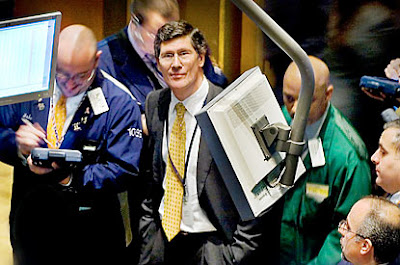 John Thain poses on the floor of
 America's World's Biggest Toilet Bowl.
Once again, one of the best and the brightest steps forward to remind us that you really have to go to one of the elite schools to prove just how dumb, corrupt, venal, criminal you are. Just how smart do you have to be to spend $35,000 on a toilet, $1.2 million on one office? You have to be Harvard smart. And that is mighty smart, by jimminy. It's George Bush smart, Antonin Scalia smart, Robert Rubin smart. Smart enough to blow trillions and trillions on nuthin' at all. (Trillions and trillions. They got Carl Sagan beat by a mile.) George W. Bush, John Thain, Antonin Scalia, Robert Rubin - Harvard, Yale men all - with a healthy representation of MIT, Chicago, Stanford, etc.
Which comes first? The sheer stupidity or the gross venality? Are these smart people who get too arrogant or fucking morons who have an easy road to privilege. I personally think that most people are fairly intelligent, given the opportunity. Sadly, most of the most never have a snowball's chance in hell. But a rich, white boy sidling his pimply ass into a seat at Harvard? Like, say, William Weld, former Governor of Massachusetts, onetime national contender. Got his political ass kicked and went on and upward to set up a money laundering operation at a diploma mill. Now that's the kind of stupid you really need a Harvard degree for. You need to go to a 'leadership institution' to manage that.
As for John Thain, MIT undergrad and HBS grad (Harvard Business School to those not privy to Cambridge-speak). Well, John Thain, super-genius, wiley bankster, favorite to take the reins at Shitigroup (umbrella logo conceived by elite designer Paula Scher) deemed it essential to blow $1.2 million on renovations to his office, including $35,000 on a toilet bowl.
And you thought it took the Pentagon to spend money like that.
But, hey, things are looking up. Obama's got Larry Summers, Timothy Geithner, Austan Goolsbee & Co. on the job.
Whoops.
And for those who may wonder . . .
Just what does a $35,000 toilet bowl look like? Well, my comrades, my droogs, I still looketh. The best so far? $2,300 for a Kohler contraption. I will update you inquirying types when I have Innnnformation.
As of 4:55pm Eastern Time, Sunday, 1 February, 2009, We Have Struck you-know-what:
 John Thain poses on the floor of
 Once again, one of the best and the brightest steps forward to remind us that you really have to go to one of the elite schools to prove just how dumb, corrupt, venal, criminal you are. Just how smart do you have to be to spend $35,000 on a toilet, $1.2 million on one office? You have to be Harvard smart. And that is mighty smart, by jimminy. It's George Bush smart, Antonin Scalia smart, Robert Rubin smart. Smart enough to blow trillions and trillions on nuthin' at all. (Trillions and trillions. They got Carl Sagan beat by a mile.) George W. Bush, John Thain, Antonin Scalia, Robert Rubin - Harvard, Yale men all - with a healthy representation of MIT, Chicago, Stanford, etc.
Which comes first? The sheer stupidity or the gross venality? Are these smart people who get too arrogant or fucking morons who have an easy road to privilege. I personally think that most people are fairly intelligent, given the opportunity. Sadly, most of the most never have a snowball's chance in hell. But a rich, white boy sidling his pimply ass into a seat at Harvard? Like, say, William Weld, former Governor of Massachusetts, onetime national contender. Got his political ass kicked and went on and upward to set up a money laundering operation at a diploma mill. Now that's the kind of stupid you really need a Harvard degree for. You need to go to a 'leadership institution' to manage that.
As for John Thain, MIT undergrad and HBS grad (Harvard Business School to those not privy to Cambridge-speak). Well, John Thain, super-genius, wiley bankster, favorite to take the reins at Shitigroup (umbrella logo conceived by elite designer Paula Scher) deemed it essential to blow $1.2 million on renovations to his office, including $35,000 on a toilet bowl.
And you thought it took the Pentagon to spend money like that.
But, hey, things are looking up. Obama's got Larry Summers, Timothy Geithner, Austan Goolsbee & Co. on the job.
Whoops.
And for those who may wonder . . .
Just what does a $35,000 toilet bowl look like? Well, my comrades, my droogs, I still looketh. The best so far? $2,300 for a Kohler contraption. I will update you inquirying types when I have Innnnformation.
As of 4:55pm Eastern Time, Sunday, 1 February, 2009, We Have Struck you-know-what:
Monday, December 8, 2008
No Shame At All
John Thain, head of Merrill Lynch and graduate of MIT Sloan School of Business, is seeking a bonus of 10 million dollars. Assuming that Thain worked 50 weeks at 50 hours per week (both overestimates, we can be sure), that bonus adds up to $4000 per hour.
Merrill Lynch is merging with Bank of America after being an early headliner in the current economic collapse. But John Thain's miserable excuse for management hasn't taught him humility.
Fortunately, New York State Attorney General Andrew Cuomo is opposing the bonus, calling it "shocking".
My suggestion: Imprison Thain and his Wall Street cohorts. With the collusion of Congress, they are bankrupting the United States, robbing us blind. Try them for treason and imprison them.
Merrill Lynch is merging with Bank of America after being an early headliner in the current economic collapse. But John Thain's miserable excuse for management hasn't taught him humility.
Fortunately, New York State Attorney General Andrew Cuomo is opposing the bonus, calling it "shocking".
My suggestion: Imprison Thain and his Wall Street cohorts. With the collusion of Congress, they are bankrupting the United States, robbing us blind. Try them for treason and imprison them.
Friday, November 28, 2008
A Wee Bit o' the Creature for Wall Street
Dark times may have fallen on the best and the brightest, that is in out time, the wealthiest, because after all, wealth is a virtue. And being wealthy is proof of intellect and competence.
It must be terribly confusing, terribly vexing, for the Gods to find that their Power is questioned, not just be The People but by Nature herself. The Boardrooms of Wall Street, like the Halls of Congress, are populated by people utterly convinced of their own superiority. So now is a time of schism. How to reconcile the facts of recent events with the dogma of superiority?
Well, if reconciliation is difficult, it can always be greased with the oil of alcohol. A bit of dutch courage. So reports The Financial Times:
It must be terribly confusing, terribly vexing, for the Gods to find that their Power is questioned, not just be The People but by Nature herself. The Boardrooms of Wall Street, like the Halls of Congress, are populated by people utterly convinced of their own superiority. So now is a time of schism. How to reconcile the facts of recent events with the dogma of superiority?
Well, if reconciliation is difficult, it can always be greased with the oil of alcohol. A bit of dutch courage. So reports The Financial Times:
The titans of Wall Street have taken a battering in the financial markets recently, but they are eating well and drinking more, according to the people who run Manhattan’s “power” dining spots.
At the 21 Club, a longtime redoubt of corporate chieftains and big names, alcohol sales are up 9 per cent from last year, and businessmen can be seen drinking $14-a-glass cocktails as early as 3pm on a weekday.
“Where people used to have one vodka on the rocks, now it’s a second one or maybe a third,” says Roger Rice, the floor manager. “I don’t know what to attribute it to. Maybe it’s the last year of the expense account.”
Others say their customers are drinking more to drown their sorrows. “People want to feel a little numb because it’s numbing out there,” says Steve Millington, general manager at Michael’s, the restaurant of choice for publishing and media executives.
Yes, they feel numb. They are also confronting the bitter truth of their own inadequacy.
Friday, November 7, 2008
Today's Rosy Headlines (or "Midway in the journey of my life, I found myself in a dark wood.")
Oooh, the good news just keeps a-rollin' in. Do not forget that enlightened right-wingers like Amity Shlaes or the editors of the Wall Street Journal or our newest political has-been John McCain believe that the 'fundamentals are sound' and this is just a dip in the gilded road of American Progress. Onward and upward, Dow 36,000 and all that. Never say 'recession' and may Lightning Strike You Down if you say the "D" word.
- Jobless Rate at 14-Year High After Big October Losses. Almost a quarter million people lost their jobs in October alone. Total job losses for the year = 1.2 million. Official unemployment up to 6.5%, meaning the real unemployment is probably around 13%. My prediction: we will see official unemployment hit 10% before we're out of this dark wood. BUT
- Stocks Are Higher After Jobs Report. Refer back to an earlier rant of mine about how Wall Street just luuuuvs bad news if it's bad for us regular little peoples.
- Retailers Report a Sales Collapse. You can only go on spending the nuthin' you do have or the sumpthin' you don't have for so long. Still waiting for Henry Paulson's announcement that he is going to inject liquidity into US. (Of course, when the Feds inject liquidity into regular folks, it's usually in the form of a lethal injection.)
- Goldman Forecasts Deepest Recession Since Reagan Era. But not for Goldman and not for its executives. It's a beautiful day in the neighborhood, a beautiful day for a neighbor. . . .
- Pending Sales of Existing Homes in U.S. Fell 4.6%. And the rental market is tightening (people forced out of homes due to foreclosures). Do you know where you're sleeping tonight?
Wednesday, October 29, 2008
Paulson Kicks Billions Back to Goldman Sachs, or Spreading the Wealth Republicon Style
Henry Paulson may be committing crimes by overpaying Goldman Sachs (his old stomping ground) and the eight other financial firms receiving the initial payout from the $700 billion bailout fund.
William Greider of The Nation has summarized and expanded upon the charge brought by Leo Gerard of the United Steelworkers Union.
The key is the deal already struck by everybody's favorite financial wiz these days, Warren Buffett. Buffett's deal with Goldman Sachs provides us with the benchmark against which to gauge the deal Paulson has struck, just twenty days following Buffett.
USW's Gerard writes,
The question I ask is: Does a Congress beholden to massive donors rather than the People care? Do they already know?
Let your members of Congress know that you know:
William Greider of The Nation has summarized and expanded upon the charge brought by Leo Gerard of the United Steelworkers Union.
The key is the deal already struck by everybody's favorite financial wiz these days, Warren Buffett. Buffett's deal with Goldman Sachs provides us with the benchmark against which to gauge the deal Paulson has struck, just twenty days following Buffett.
USW's Gerard writes,
"I am sure that someone at Treasury saw the terms of Buffett’s investment. In fact, my suspicion is that you studied it pretty closely and knew exactly what you were doing. The 50-50 deal — 50% invested and 50% as a gift — is quite consistent with the Republican version of the “spread-the-wealth-around” philosophy that seems so much in vogue."Greider asks the obvious question: Will anyone take notice in the midst of the election campaign chaos?
The question I ask is: Does a Congress beholden to massive donors rather than the People care? Do they already know?
Let your members of Congress know that you know:
In Case You Forgot, the Environment is a Disaster
The World Wildlife Fund has released its Living Planet Report. There's some good news and there's some bad news.
The good news is: We ain't dead yet. The bad news is: We will be, we will be.
The report concludes that "Humanity's demands exceed our planet's capacity to sustain us" (as if that was news). Britain's Guardian newspaper has a nice summation of the reports findings, which can be boiled down to
People like Michael Bloomberg or Stephen Schwarzman (the Blackstone chief who threw himself a multi-million dollar birthday party) use 100,000% more than the Earth can replenish. BUT THAT IS THEIR GOD-GIVEN RIGHT, by God! And if you suggest otherwise, you're an America-hating, Palin-bashing, anti-American Commie Pinko Socialist Marxist Anarcho-syndicalist BASTURD!
BUT there is a silver lining:
IF, by the 2030s (a big twenty years away), we can find A SECOND EARTH, we can all keep living just the way we are now.
So, Solution 1: The Earth 2 Buyout Fund. Congress must allocate $750 TRILLION to find and acquire Earth 2. Alternatively, we can use Earth 1 to build Earth 2. . . . No, no, that's not it. We can clone Earth 1. Or maybe we can do that thing like in Arthur C. Clarke's 2010, only use Jupiter to manufacture Earth 2. That would create jobs. (I am announcing my candidacy for President of the United Nations based on a platform of job creation through Jupiter reconstruction for Earth 2.)
Solution 2, favored by Republicons, Bloombergs and other fascists: Find a way for 99.99% of the world's population to live on 10% of the absolute minimum needed for basic human survival so that Wall Street, innately superior Corporate Executives, and members of Congress can live on the remaining 100,000%. Advantage: This is the solution already being worked on by Michael Bloomberg, Bush, McCon, Palin, and company.
Do I sound a little sarcastic? Pessimistic? Cynical? I apologize. Something about chronically suicidal, species-wide self-annihilation, endorsed by the enlightened 'experts' and 'leaders', just gets me a little down. That's all.
Plus. . . . I have a friggin' cold.
In the future, I will do my best to be more optimistic about the tiny tiny minority of self-appointed über-supremicists destroying the lives of the rest of us.

The good news is: We ain't dead yet. The bad news is: We will be, we will be.
The report concludes that "Humanity's demands exceed our planet's capacity to sustain us" (as if that was news). Britain's Guardian newspaper has a nice summation of the reports findings, which can be boiled down to
"[H]umans are using 30% more resources than the Earth can replenish each year, which is leading to deforestation, degraded soils, polluted air and water, and dramatic declines in numbers of fish and other species."That's the average for the world as a whole. Humans in civilized countries like the United States are only using maybe 900% more resources than the Earth can replenish.
People like Michael Bloomberg or Stephen Schwarzman (the Blackstone chief who threw himself a multi-million dollar birthday party) use 100,000% more than the Earth can replenish. BUT THAT IS THEIR GOD-GIVEN RIGHT, by God! And if you suggest otherwise, you're an America-hating, Palin-bashing, anti-American Commie Pinko Socialist Marxist Anarcho-syndicalist BASTURD!
BUT there is a silver lining:
IF, by the 2030s (a big twenty years away), we can find A SECOND EARTH, we can all keep living just the way we are now.
So, Solution 1: The Earth 2 Buyout Fund. Congress must allocate $750 TRILLION to find and acquire Earth 2. Alternatively, we can use Earth 1 to build Earth 2. . . . No, no, that's not it. We can clone Earth 1. Or maybe we can do that thing like in Arthur C. Clarke's 2010, only use Jupiter to manufacture Earth 2. That would create jobs. (I am announcing my candidacy for President of the United Nations based on a platform of job creation through Jupiter reconstruction for Earth 2.)
Solution 2, favored by Republicons, Bloombergs and other fascists: Find a way for 99.99% of the world's population to live on 10% of the absolute minimum needed for basic human survival so that Wall Street, innately superior Corporate Executives, and members of Congress can live on the remaining 100,000%. Advantage: This is the solution already being worked on by Michael Bloomberg, Bush, McCon, Palin, and company.
Do I sound a little sarcastic? Pessimistic? Cynical? I apologize. Something about chronically suicidal, species-wide self-annihilation, endorsed by the enlightened 'experts' and 'leaders', just gets me a little down. That's all.
Plus. . . . I have a friggin' cold.
In the future, I will do my best to be more optimistic about the tiny tiny minority of self-appointed über-supremicists destroying the lives of the rest of us.
More Good News! Bonuses Are UP!
According to Bloomberg News,
Fuhgeddaboudit! Your taxes will be going UP UP UP so that Wall Street Billionaires can amass more billions. Billions in bonuses for destroying the world economy. Maybe these people also feel the Nazis deserved the Nobel Peace Prize.
"More than one-third of Wall Street employees . . . expect a bigger bonus this year than last year even amid the worst financial crisis since the Great Depression."Guess where the money for those bonuses will be coming from. Have you lost your job this year? Faced pressure to accept a pay cut? Wondering how to pay off the credit cards? Worried about your mortgage?
Fuhgeddaboudit! Your taxes will be going UP UP UP so that Wall Street Billionaires can amass more billions. Billions in bonuses for destroying the world economy. Maybe these people also feel the Nazis deserved the Nobel Peace Prize.
Tuesday, October 28, 2008
Dow Up 10% — Nearly 900 Points — What's the Good News?
Consumer confidence dropped to its lowest point ever.
Prices of single-family homes dropped by the greatest percentage ever in August.
New York State Governor Paterson forecast a budget shortfall next year of $12.5 billion (up nearly 100% from what was projected a few months ago) and a total of $47 BILLION in shortfalls over the years ahead.
Job losses for New York State will likely exceed 150,000.
Job losses nationwide for 2008 currently exceed 500,000 (yeah, half a million).
Time, Inc. is cutting 600 jobs (10% of workforce).
Whirlpool plans to cut 5,000 jobs (6.8% of workers).
Home foreclosures continue at a pace unprecedented in American history.
This is the kind of good news that lifts the hearts and minds of Wall Street. AND, there are bargains to be had! The Fed may lower interest rates on Wednesday, October 28! SO BUY! BUY! BUY!
More important, the bad news is bad for regular people — 'Main Street' in the term of the day — so Wall Street reacts favorably. Make average and poor Americans poorer, Wall Street gets richer. And with the Bailout, the government has abandoned any pretense of acting in the public's interest.
Prices of single-family homes dropped by the greatest percentage ever in August.
New York State Governor Paterson forecast a budget shortfall next year of $12.5 billion (up nearly 100% from what was projected a few months ago) and a total of $47 BILLION in shortfalls over the years ahead.
Job losses for New York State will likely exceed 150,000.
Job losses nationwide for 2008 currently exceed 500,000 (yeah, half a million).
Time, Inc. is cutting 600 jobs (10% of workforce).
Whirlpool plans to cut 5,000 jobs (6.8% of workers).
Home foreclosures continue at a pace unprecedented in American history.
This is the kind of good news that lifts the hearts and minds of Wall Street. AND, there are bargains to be had! The Fed may lower interest rates on Wednesday, October 28! SO BUY! BUY! BUY!
More important, the bad news is bad for regular people — 'Main Street' in the term of the day — so Wall Street reacts favorably. Make average and poor Americans poorer, Wall Street gets richer. And with the Bailout, the government has abandoned any pretense of acting in the public's interest.
Monday, October 27, 2008
Bailout for BONUSES!

Weegee. "The Critic", November 22, 1943. The war was on. We were still in the Depression. Look familiar?
The sheer Audacity of Greed. This is why the architects of Christianity invented Hell. There has to be some place where justice is finally meted out to evil monsters who steal from us and run organized crime machines like Goldman Sachs, Merrill Lynch, Lehman, Bank of America, and on and on. The People need some assurance that sooner or later these revolting worms will get what the United States government is absolutely unwilling to do. Thus Heaven for the poor, Hell for the leaches who make us poor. (1)
What am I raving about? The Boneses for Wall Street execs. Bloomberg news has a report on the BILLIONS being set aside by Goldman Sachs and others to kick back to their financial charlatans this holiday season.
My guess is that Michael Bloomberg, if he says anything, will support these kickbacks. First, these thieves are his friends. Second, for years it has been their obscene pay — and theirs alone — that has sustained the broader obscenity of New York City real estate prices.
Things were already bad. Over a year ago, reports flashed across the journalistic radar of the multimillion dollar party that Blackstone head Stephen Schwarzman had thrown for himself. But now We the People are pulling their asses out of the fire. We get laid off. We lose our homes. And they get bonuses totalling billions and billions of dollars. Perhaps Andrew Cuomo or someone with a comparable sense of decency will go after these beasts. We can be sure it will not be anyone in Washington, DC, including, I suspect, Barack Obama if elected.

The Schwarzman 60th birthday bash in 2007 included $1 million for Rod Stewart. Schwarzman, a Republicon, has said, "I don’t feel like a wealthy person."I'm trying to imagine some historical or fictional representation of the poor or regular people coming upon the trappings of wealth.
Perhaps A Night To Remember — the classic 50s film about the sinking of the Titanic — when the steerage passengers, initially barred from reaching lifeboats (fact), finally break through the gates and pass through the first class areas of the ship.
Or perhaps the experience of the French peasants on overthrowing Louis XVI and seeing, however briefly the staggering wealth of the monarchy (before the Reign of Terror and Robespierre et al. tried to make themselves monarchs in all but name) .
It should bring tears to our eyes. Or rage. But most Americans seem unmoved. Rather, people lionize, idolize — American Idolize — the rich. "Future, Heaven of the poor" said poet W. S. Merwin. "In the Future, I'll win the lottery, become a star baseball player, an actor. I'll be rich, so they are my peers." Needless to say, the rich do not agree. Years ago, when I lived in Boston, a report emerged during a surge of public opposition to a very modest tax increase: Of those who bought lottery tickets, most spent more on lottery tickets than they paid in taxes each year. Such is the state of our delusions.
For a moment, we were moved by the bailout, moved to flood Congress with calls and emails. So the first pass at a bailout bombed. But now it's old news. And people like "Joe the Plumber" — middle class people — can still seriously fret over 'tax and spend' Democrats, as if a lottery win were just around the corner, just about to make us millionaires and catapult us into the party with Michael Bloomberg, Stephen Schwarzman, Henry Paulson.
Where are our tears? If We the People have no sense of decency, how can we condemn the self-appointed UberVölk of Congress and Wall Street?
NOTES
1. I don't know much about the intellectual history of Western religion, but it has always seemed to me that religion played a terribly important role in mollifying a possibly restless serfdom. "Things suck now, and the Lords live off the fat of our labour, but someday we will be rewarded for our suffering." Thus the religious class taught the poor while, of course, allowing the rich to buy their 'indulgences' for entry to Heaven.
Today, the religious class roughly parallels the politically powerful. (Not quite right, because we worship before the feet of the corporate elite, too.) The rich corporate Titans buy their indulgences in the form of bribes (called campaign contributions) to politicians.
I don't think it's any coincidence that, as times have gotten worse in recent years and particularly as disparities in the distribution of wealth of grown ever more extreme, people are turning more to religion. Increasingly, Americans are abandoning any hope of a good life and praying instead for a good life after.
2. New York Times essayist and conservative idiot Ben Stein has some vaguely relevant blather about a year ago. It should surprise none that he was dead wrong on very nearly every point. But he has a cool Ivy degree and that annoying delivery, so he must have been right even though he was wrong. That's religion, folks.
3. The Bride Wore Ritzy. New York Times, 22 April 2008
Attack of the Bailout Behemoth
We've already heard that the insurance and automotive industries are nosing up to the trough for money money money from Uncle Sam — meaning Us. The US slot is payin' big time, and the bigger you are, the bigger you get!
The Christian Science Monitor has a nice little survey of the Mighty Morphin' Money Machine.
Now, the US (unlike the British) has included NO requirement that banks actually dole out the money they get. As many have noted, Goldman Sachs et al. could just sit on that pile of dough until hell freezes over — or until it's Bonus Time in Bloombergburg.
What the insurance industry or the car makers will do if they get on the gravy train is anybody's guess. But we can safely say it won't involve cutting insurance rates, lowering car prices, or guaranteeing a better product (e.g., affordable hybrid autos).
Back in the 80s the US car makers moaned and moaned and moaned — "boo hoo boo hoo, if only we could get a little breathing space from the Japanese, we could improve our cars and become more competitive". The Japanese gave in to the sob story, voluntarily restricted exports to the US.
What did Our Glorious Car Makers do? They raised prices.
The Shape of Things to Come.
SEE ALSO
Broken Securities Industry Still Has $20 Billion to Pay Bonuses. Bloomberg, 27 October 2008.
Merrill Brokers May Get Big Bonuses to Stay. New York Times, 24 October 2008
Car makers may be next up for bailout. CNN, 27 October 2008
The Christian Science Monitor has a nice little survey of the Mighty Morphin' Money Machine.
Now, the US (unlike the British) has included NO requirement that banks actually dole out the money they get. As many have noted, Goldman Sachs et al. could just sit on that pile of dough until hell freezes over — or until it's Bonus Time in Bloombergburg.
What the insurance industry or the car makers will do if they get on the gravy train is anybody's guess. But we can safely say it won't involve cutting insurance rates, lowering car prices, or guaranteeing a better product (e.g., affordable hybrid autos).
Back in the 80s the US car makers moaned and moaned and moaned — "boo hoo boo hoo, if only we could get a little breathing space from the Japanese, we could improve our cars and become more competitive". The Japanese gave in to the sob story, voluntarily restricted exports to the US.
What did Our Glorious Car Makers do? They raised prices.
The Shape of Things to Come.
SEE ALSO
Broken Securities Industry Still Has $20 Billion to Pay Bonuses. Bloomberg, 27 October 2008.
Five straight quarters of losses and a 70 percent slide in its stock this year haven't stopped Merrill Lynch & Co. from allocating about $6.7 billion to pay bonuses.Goldman Sachs Group Inc. and Morgan Stanley, both still on track for profitable years, have set aside about $13 billion for bonuses after three quarters, down 28 percent from a year ago. Even some employees at Lehman Brothers Holdings Inc., which declared the biggest bankruptcy in U.S. history last month, will get the same bonus they received a year ago.
Merrill Brokers May Get Big Bonuses to Stay. New York Times, 24 October 2008
Car makers may be next up for bailout. CNN, 27 October 2008
Wednesday, October 22, 2008
NPR — National Plutocrat Radio
Where is the public in National Public Radio? In the past 20 years or so, it has steadily ceased to be what it promised at the time of its founding (if it ever was that to begin with).
Coverage of the Middle East, the US government and especially its foreign policy, and virtually any topic that requires more than a generic bachelors degree in some gut subject goes woefully under-reported. The most notable individual cases coming immediately to mind are Nina Totenberg's glaring failure to follow up after she broke the Anita Hill challenge to Clarence Thomas in 1991 and the consistently biased reporting from Israel/Palestine of Linda Gradstein, who was found to have accepted payment from pro-Israel organizations in violation of NPR's own published standards.
NPR's coverage of the first Gulf War and now of the Iraq War was almost devoid of anything that would pass for journalistic scrutiny. Now its coverage of the Wall Street chaos is matching that low.
In the case of Wall Street we should perhaps expect this. Among NPR's Board of Directors are several with degrees from Harvard, Chicago, Yale — institutions well-represented on Wall Street and in recent administrations — but more importantly, institutions that lead the US in encouraging and unquestioning acceptance of and obedience to "authority". Scroll to the end of this entry for a brief rundown of some of the behind-the-scenes automatons at NPR.
Below is an expanded version of a letter sent to NPR regarding its October 22nd interview with former SEC chair William Donaldson:
Coverage of the Middle East, the US government and especially its foreign policy, and virtually any topic that requires more than a generic bachelors degree in some gut subject goes woefully under-reported. The most notable individual cases coming immediately to mind are Nina Totenberg's glaring failure to follow up after she broke the Anita Hill challenge to Clarence Thomas in 1991 and the consistently biased reporting from Israel/Palestine of Linda Gradstein, who was found to have accepted payment from pro-Israel organizations in violation of NPR's own published standards.
NPR's coverage of the first Gulf War and now of the Iraq War was almost devoid of anything that would pass for journalistic scrutiny. Now its coverage of the Wall Street chaos is matching that low.
In the case of Wall Street we should perhaps expect this. Among NPR's Board of Directors are several with degrees from Harvard, Chicago, Yale — institutions well-represented on Wall Street and in recent administrations — but more importantly, institutions that lead the US in encouraging and unquestioning acceptance of and obedience to "authority". Scroll to the end of this entry for a brief rundown of some of the behind-the-scenes automatons at NPR.
Below is an expanded version of a letter sent to NPR regarding its October 22nd interview with former SEC chair William Donaldson:
NPR continues its grossly inadequate, essentially conservative, reporting on the financial crisis with its October 22nd interview of William Donaldson.Here's a rundown of some of NPR's board members:
Absent from NPR's interview is any mention that Donaldson was Chairman of the SEC during a crucial period of deregulation. Donaldson’s comments about deregulation are hardly those of a disinterested "expert". Like Robert Rubin and others, he now has a vested interest in protecting his own reputation (and now doubt his considerable personal wealth).
Indeed, Donaldson, like the rest of the SEC, uniformly advocated deregulation. In April 2004, the SEC released firms like Goldman Sachs (then lead by Henry Paulson) from the "net capital rule" which required them to hold in reserve capital, effectively limiting their borrowing. This was a crucial step in the lead-up to the current chaos.
Donaldson is quite wrong when he describes the US as the "gold standard" on deregulation. The Europeans -- on a number of fronts, not just financial -- have advocated greater regulation to protect average people (as opposed to protecting the wealthy or priviledged) and out of what many might say is an interpretation of democratic principles which surpasses that of the nation that calls itself the “world’s greatest democracy”.
As for the specific claim that better (meaning, more lax) US regulation made the US more attractive to investors globally: Of course the US was more attractive when it was easier to make a quick buck here. How attractive is the US now?
It is genuinely astonishing, and shameful, that NPR fails utterly to question Donaldson on exactly those points where he has a personal axe to grind. NPR brings out NONE of Donaldson's personal record, none of the points on which his personal record is relevant. Surely an awareness of his own involvement would influence listeners' willingness to take another Wall Street snake-oil salesman at his word.
This is entirely in keeping with NPR's reporting which has largely failed to investigate or scrutinize either the Wall Street failures or the government and business claims about them.
One telling characteristic of interviews like today’s is that NPR (and many other American news businesses) abandon the “he said/she said” approach which will be found in discussions of, say, evolution vs. “intelligent design”. There are many flaws in that approach, but on topics like that addressed by Donaldson, that approach might serve quite well. But of course, it might also serve to undermine the line that Donaldson is taking, a line that NPR has bought into over weeks of reporting.
- Kevin Klose, President of NPR - B.A. Harvard
- Antoine W. van Agtmael, Chair of NPR Foundation - M.A. Yale, M.B.A. NYU Stern
- John A. Herrmann Jr., Vice Chairman of Lincoln International, former Managing Director in the M&A practice at JP Morgan Securities - B.A. Yale, M.B.A. Harvard
- Lyle Logan, Executive Vice President, The Northern Trust Company - M.B.A. Chicago
- Howard H. Stevenson, Baker Foundation Professor and the Sarofim-Rock Professor of Business Administration, Emeritus at Harvard Business School
Subscribe to:
Posts (Atom)

 Posts
Posts


“…they believe that it would actually make us less stable. Because the individual banks would be less diversified….”
Summers statements like these make it painfully clear that he is making stuff up as he goes along to serve his pre-determined conclusion. It is trivially false that mere size provides a stabilizing buffer. For example, so and so can have one million shares in one company or one million shares in one million companies. Mere size has nothing to do with it.
I would guess that Summers, like many economists, is fond of analogies, since the mathematics of economics is actually quite weak. (First, real economic systems, as should by now be all too clear, are radically non-linear, which is why major players like Goldman Sachs jealously guard their masters of computational methods. Second, the simplifications economists routinely champion are, in the real world, gross over-simplifications, throwing the baby out with the bath water.)
The analogy Summers tacitly relies upon is that with greater size, there is greater inertia. But then the analogy is a little too apt. Greater size results in less innovation, less agility, less flexibility to respond to change or the unexpected.
(How’s that paragraph for mixing metaphors?!)
The thing is, Summers (and Geithner, Bernanke, Paulson, Congress and Obama) like big banks. Big Is Beautiful! Having big financial institutions in the economic world is like having big guns, big bombs, big ships in the military. We can make others cower. Never mind that, again pursuing an analogy, there are a great many examples from history of the smaller, more agile foe, outdoing the bigger. Of course, Summers & Co. are hoping for an economic blitzkrieg — large and lightning fast.